
Techshin Map.
Every agent doing work in your business sits with someone. Techshin Map is a structured governance process for working through every position, role, task, and AI agent in your business and recording who owns each one. So when the board asks you can answer. When someone leaves nothing is orphaned. When AI does the work you still carry the accountability.
See the full platform →
Techshin Map is available to Techshin Partners clients. Start with a conversation.
Start the conversationYou cannot govern what you cannot see. And right now most businesses cannot see their AI.
Agents are doing real work. Nobody knows who approved them. Nobody knows who is accountable if something goes wrong.
AI agents are already inside your business. Some you know about. Some you do not. They are running inside your CRM, your finance system, your inbox, your scheduling, your customer service. Some were approved properly. Some were not. Most are not visible in the structure of the organisation. Most have no named human overseer on record.
When something goes wrong and a board, regulator, insurer, or court asks who was responsible for that agent and what it was authorised to do, the business needs an answer. You cannot point at the AI. You cannot say nobody approved it. You cannot say you did not know it was there. Techshin Map gives you the structure and the process to build that answer before you need it.
AI will not fix weak operating discipline.
It will expose it.
If processes are unclear, AI accelerates the confusion. If ownership is unclear, AI creates accountability gaps. If there is no record of who approved what, nobody can answer the hard questions when they arrive.
Most organisations are approaching AI from the wrong starting point. They begin with tools, pilots, and productivity promises. The starting point is not the tool. The starting point is knowing who is responsible for the work the tool is doing.
You cannot swear an AI into court. Someone has to own what it does.
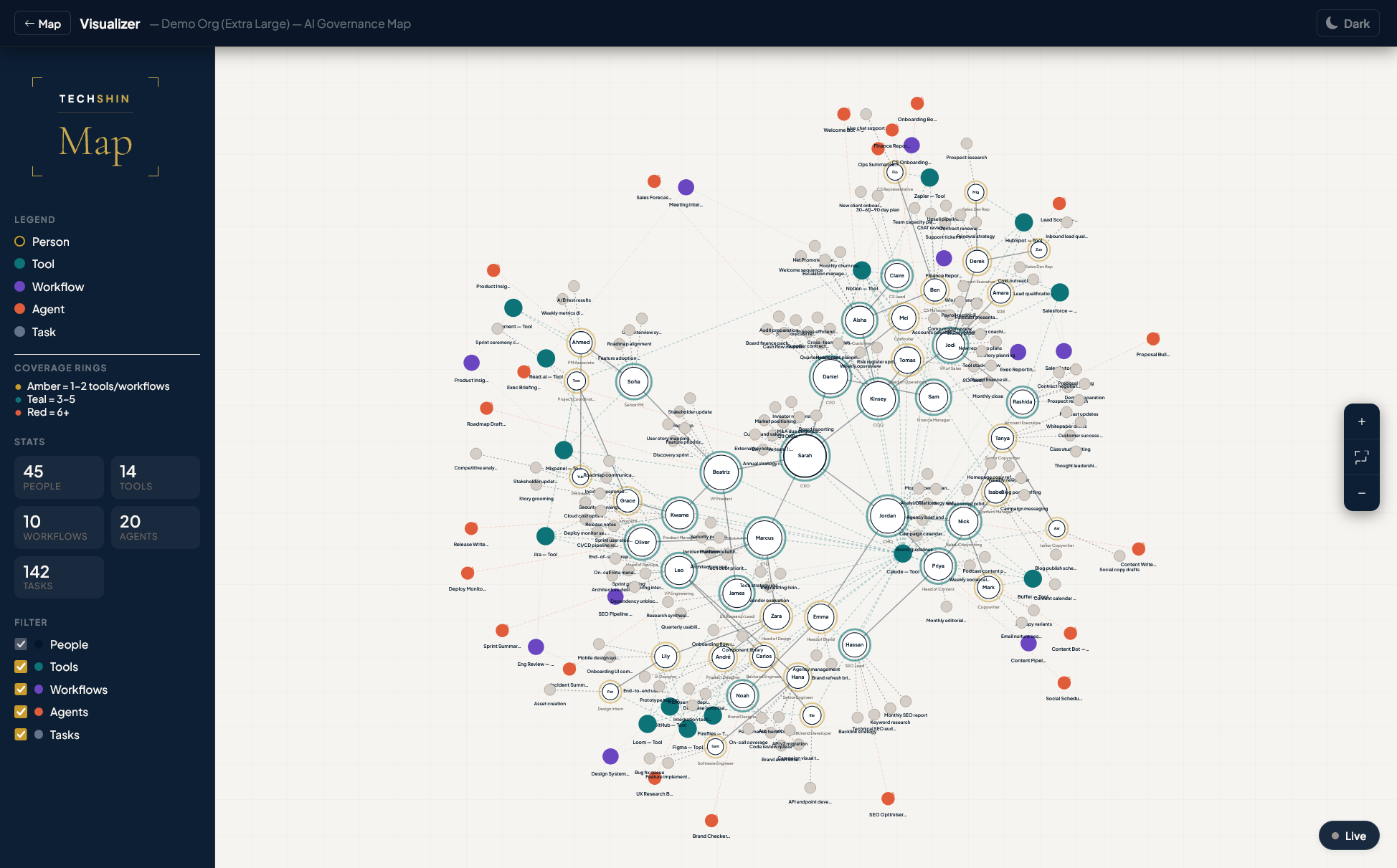
See what governance looks like from the inside.
Live org chart, registers, visualizer, sprint board, document vault — the full governance environment your leadership team can actually see and act on.
Explore the full platform →Four layers. One accountability chain.
The mapping process works through four layers. Nothing floats. Everything traces back to a human who is accountable for it. An agent replaces a task. Not a role. Not a position. A task. But the chain from that task to a named human never breaks.
The process works through four layers deliberately. Your leadership team sits down and works through each position. The roles inside it. The tasks inside each role. And for every task the question is asked. Is this done by a human. Is it automated. Is it augmented by AI. Or is it fully agentic. Every answer is recorded and owned.
When all the tasks inside a role are handled by agents, that role no longer needs a doer. It only needs a director. When all the roles inside a position reach that point, the position itself transforms. From doing to directing. The process shows you when that threshold is approaching before it catches anyone by surprise.
A tool is just a tool. A workflow is tools connected. The moment that workflow attaches to a real task inside a real role inside a real position it becomes an agent. That is when it must be named. That is when a human overseer must be assigned. That is when the decision gets logged.
Every decision logged. Every successor informed.
When someone moves a task to an agent that decision is recorded. Who made it. When. Why. What the agent is authorised to do. Who oversees it. When someone new takes a position they see every decision they now carry. The chain never breaks even when people leave.
It is great to walk into a new position and find the AI handles most of the work. But what you are also walking into is accountability for every decision made before you arrived. Most people have no idea what that means until something goes wrong.
When a new person takes a position, Techshin Map shows them every active agent decision they now carry. They must review each one. Acknowledge it. Or escalate it to the person above them for review. The chain of accountability never breaks even when people leave.
When a board, regulator, insurer, or court asks who approved this agent and who was accountable for it, the answer has to come from a human. That human needs to show a decision log proving they understood what they were responsible for. Techshin Map creates that log automatically as every decision is made.
Succession review required
James Harlow has taken the Customer Service Manager position. There are 6 active agent decisions made by the previous holder that John now carries accountability for. Review required.
14 Mar 2026
02 Feb 2026
14 Mar 2026
Three reasons businesses map right now.
Different entry points. Same product. Same outcome. Every agent visible. Every responsibility owned. Every decision logged.
Techshin Map makes the problem visible. The AI Framing Sprint builds the structure to fix it properly. When a business maps their organisation and sees the governance gaps clearly for the first time, the next step is building the GEM Blueprint operating model and SOAP foundation that the map operates within. The two work together naturally.
Learn about the AI Framing Sprint ↗Available to Techshin Partners clients.
Techshin Map is a governance process included in the AI Framing Sprint and in monthly Techshin Partners engagements. It is not available as a standalone subscription. The process only makes full sense inside the structure of an engagement where GEM Blueprint and SOAP provide the foundation. That is by design.
Techshin Map sits inside the engagement. When you are in the AI Framing Sprint, the mapping process is how you build and document the governance picture of your organisation. When you are in a monthly retainer engagement, the map grows and is maintained as the engagement progresses and new agents enter the business.
The process does not work in isolation. It works because the engagement provides the context. GEM Blueprint gives the operating model. SOAP gives the foundation. The AI Framing Sprint builds both. Techshin Map records the result and keeps it live and exportable.
If you are not yet a Techshin Partners client the place to start is a thirty minute conversation. No cost. No pitch. We confirm fit and scope. If we are not the right fit we will say so on the call.
Techshin Map shows you where the gaps are. The practice areas close them.
C-Level Technology Leadership →
The identity shift from order taker to impact maker. The leader the business needs in an AI world.
Board Technology Leadership →
Governance, literacy, and the capability to direct technology at the highest level.
AI Framing Sprint →
Six weeks. GEM Blueprint and SOAP. The operating model that Techshin Map sits inside.
Your agents are already doing real work.
Do you know who owns them?
Techshin Map is available to Techshin Partners clients. Start with a thirty minute conversation. No cost. No pitch. We confirm fit and scope. If we are not the right fit we will say so on the call.
Start the conversationWant to understand the operating model first?
See the AI Framing Sprint ↗